April 23, 2026
One Day Equals a Thousand Years: What the Days of Creation Actually Represent
Does One Day Really Equal a Thousand Years in the Bible?
This is not a metaphor. It is not poetry. It is the key that unlocks the entire prophetic timeline of Scripture — and it has been hiding in plain sight since Genesis 1, where each day of creation maps to a thousand years of earth's history.
Psalm 90:4 says it plainly:
For a thousand years in Your sight are but as yesterday when it is past, and as a watch in the night. — Psalm 90:4
One day in AO's sight equals a thousand years. And even the New Testament confesses the same truth:
But, beloved, be not ignorant of this one thing, that one day is with the Lord as a thousand years, and a thousand years as one day. — 2 Peter 3:8
Christianity reads this verse. Christianity quotes this verse. And yet Christianity completely misapplies it — because they place the final thousand years in heaven during a so-called "millennial reign," rather than here on earth where the rest of Scripture demands it.
The math does not work their way. But it works perfectly AO's way.
What Do the Seven Days of Creation Actually Represent?
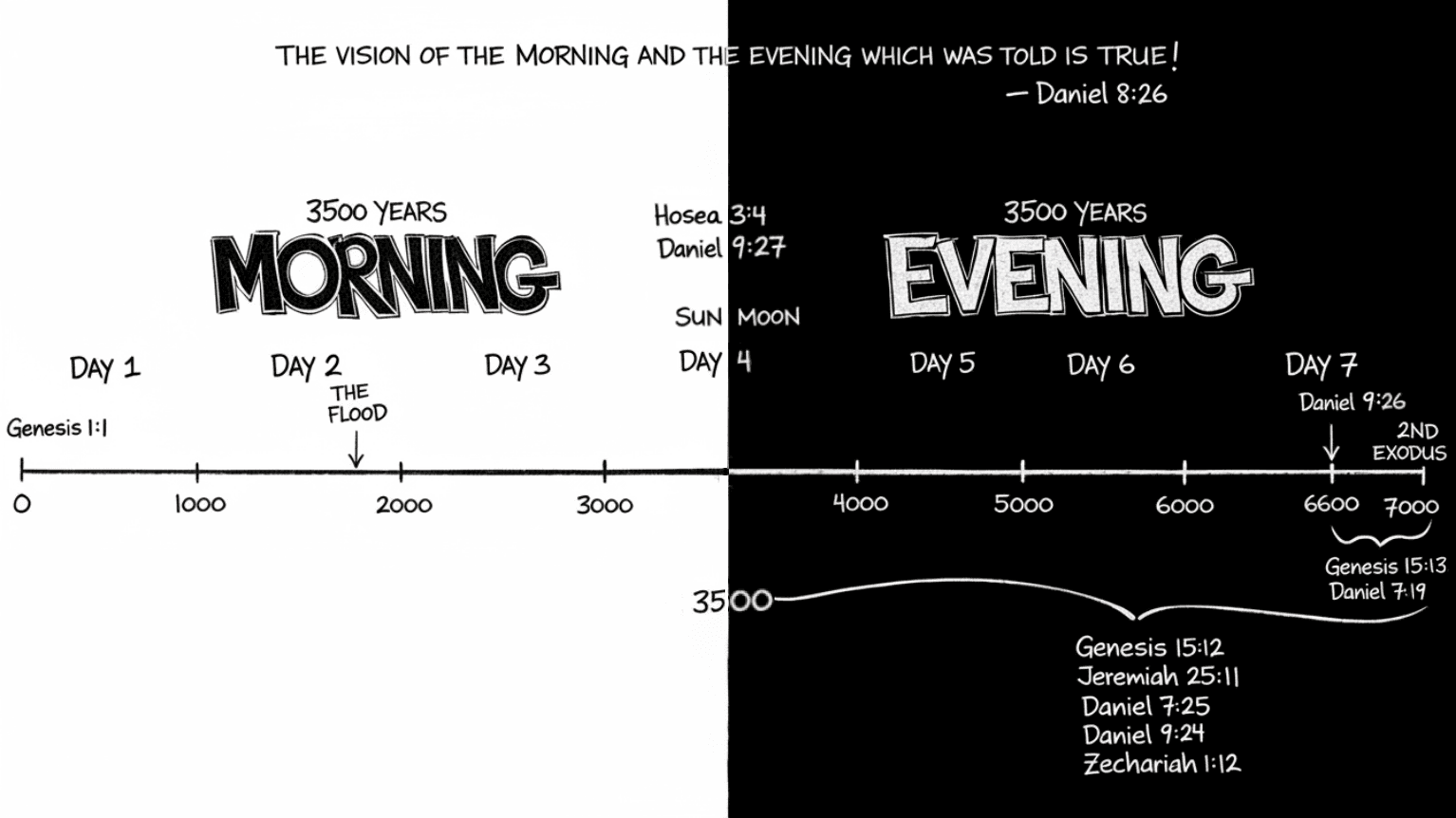
If one day equals a thousand years, then the seven days of creation represent seven thousand years of earth's history. This is the vision of the morning and the evening described in Daniel 8:26:
And the vision of the
eveningmorning and themorningevening which was told is true. — Daniel 8:26
Seven thousand years. One complete week. And just like a day has a morning and an evening, earth's history has a period of light and a period of darkness — split down the middle.
Three thousand five hundred years of light. Three thousand five hundred years of darkness. The morning vision and the evening vision.
The morning vision begins at creation and runs through the history of Israel — Abraham, Moses, the exodus, the conquest, the kingdom of David — until the temple is destroyed and the children of Israel are cut off. That is the transition from day to night. The sun sets. The evening vision begins.
And the evening vision? That is the period we are living in now.
What Does Daniel 9:27 Mean by "In the Middle of the Week"?
This is where Christianity's math falls apart — and where AO's perfection shines through.
And He shall confirm the covenant with many for one week, and in the middle of the week He shall cause the sacrifice and the oblation to cease. — Daniel 9:27
One week equals seven thousand years. AO confirms His covenant with His people for the entire span of earth's history. But in the middle of the week — at the midpoint — the sacrifice and oblation cease. The temple is destroyed. The children of Israel are cut off.
Now here is the question that Christianity cannot answer: what is half of seven thousand?
Three thousand five hundred. Not three thousand.
If the "millennial reign" removes the last thousand years and places them in heaven, then you only have six thousand years of earth's history. Half of six thousand is three thousand — not three thousand five hundred. The math does not work. The middle of the week cannot land where it needs to land.
But seventy jubilees — seventy times fifty — equals three thousand five hundred years. And that is exactly what Daniel 9:24 tells us:
Seventy
weeksjubilees are determined upon your people and upon your holy city, to finish the transgression, and to make an end of sins, and to make reconciliation for iniquity, and to bring in everlasting righteousness, and to seal up the vision and prophecy, and to anoint the most holy. — Daniel 9:24
Seventy jubilees. Three thousand five hundred years. The evening portion of the vision — the period of darkness that follows the destruction of the temple and the cutting off of Israel.
AO is perfect. The math is perfect. The middle of the week is three thousand five hundred years, and seventy jubilees confirms it. And the King of Fierce Countenance will be the final judgment upon that darkness.
What Is "Time, Times, and Half a Time"?
The same number appears yet again in Daniel's prophecy of the saints being worn out by the fourth beast:
And he shall speak great words against the most High, and shall wear out the saints of the most High, and think to change times and laws: and they shall be given into his hand until a time and times and the dividing of time. — Daniel 9:24
If a "time" is a thousand years, then "times" is two thousand years, and "half a time" is five hundred years. One thousand plus two thousand plus five hundred equals three thousand five hundred.
The same number. The same period. The evening vision. The darkness. The Babylonian exile that has never ended.
The lamp goes out. The children of Israel are left without a king, without a prince, without a sacrifice, without an image, without an ephod, and without teraphim — exactly as Hosea describes:
For the children of Israel shall abide many days without a king, and without a prince, and without a sacrifice, and without an image, and without an ephod, and without teraphim. — Hosea 3:4
This is not ancient history. This is now. The children of Israel have been in this condition for three thousand five hundred years — the entire evening portion of the vision. No king. No prince. No temple. No sacrifice. No functioning priesthood.
And Christianity and Second Temple Judaism want you to believe the captivity ended with Cyrus? If Cyrus ended the captivity, then Babylon should have been destroyed and left desolate, and people should hiss at it — exactly as Jeremiah prophesied. But Babylon was not destroyed. The captivity was not ended. The evening vision continued.
What Does Deuteronomy 31:17-18 Tell Us About the Final 1,000 Years?
Christianity teaches that the final thousand years — the "millennium" — will be spent in heaven with the Messiah while earth sits empty. But Scripture says the opposite. The darkness is not a vacation. It is judgment — and the final thousand years are the most brutal, when AO withdraws completely and rests:
17 Then My anger shall be kindled against them in that day, and I will forsake them, and I will hide My face from them, and they shall be devoured, and many evils and troubles shall befall them; so that they will say in that day, Are not these evils come upon us, because our God is not among us?
18 And I will surely hide My face in that day for all the evils which they shall have wrought, in that they are turned unto other gods. — Deuteronomy 31:17–18
AO hides His face. He rests — not in the sense of relaxation, but in the sense of withdrawal. He steps back from His people because of their rebellion, and the darkest portion of the night begins.
Remember, the night is always darkest before the dawn.
What Did Abraham See in Genesis 15?
The vision of the morning and the evening is not only found in Daniel. It appears in the very first covenant AO makes with Abraham:
And when the sun was going down, a deep sleep fell upon Abram; and, lo, an horror of great darkness fell upon him. — Genesis 15:12
As the morning transitions to the evening — as the sun sets — a deep sleep falls upon Abram (Abram, not Abraham, just like Jacob before his struggle and his name change). And then he sees a horror of great darkness.
This is not a coincidence. Abraham, who represents Israel, falls into a deep sleep at the exact moment the sun goes down. The evening vision begins.
For AO hath poured out upon you the spirit of deep sleep, and hath closed your eyes: the prophets and your rulers, the seers hath He covered. — Isaiah 29:10
What does AO show Abraham in that darkness?
13 And He said unto Abram, Know of a surety that thy seed shall be a stranger in a land that is not theirs, and shall serve them; and they shall afflict them four hundred years;
14 and also that nation, whom they shall serve, will I judge: and afterward shall they come out with great substance. — Genesis 15:13–14
Four hundred years of affliction. A nation judged. And afterward — a coming out with great substance. This is the Second Exodus. The end of the evening vision. The dawn that follows the darkest night.
Why Does the New Testament Use "Two Days" Symbolism?
Here is something Christianity confesses without realizing what it means.
Throughout the New Testament narrative, the pattern of "two days" appears repeatedly — and it is not subtle. In John 11, the Messiah figure waits two days before going to raise Lazarus from the dead. In John 4:40, he stays with the Samaritans for two days. And in the parable of the Good Samaritan in Luke 10:35, the Samaritan gives the innkeeper two pence — two days' wages — and says, "When I come again, I will repay thee."
Two days. Two thousand years. Over and over, the New Testament embeds this number into its stories because the authors understood the principle of Psalm 90:4 — that a day equals a thousand years — and they were encoding a timeline into their narrative.
Christianity reads these passages and arrives at a conclusion that feels imminent: roughly two thousand years must pass before the Messiah returns. This is why movements like Messiah 2030 have gained so much traction — because if you count two thousand years from the start of his ministry, you land around 2027. From the crucifixion, you arrive at 2030 or 2033, depending on which date you use. Christianity itself cannot agree on the starting point, which is why the predictions keep shifting.
But here is the deeper problem: Christianity's entire framework assumes we are heading toward the end of six thousand years — that the Messiah came at roughly the four-thousand-year mark of earth's history, and that two thousand years later, at year six thousand, he returns to begin a "millennial reign" in heaven for the final thousand.
This is the deception. It is the world's timeline — not AO's.
We are not heading toward the end of six thousand years. We are heading toward the end of seven thousand. Earth's history is seven days — seven thousand years — and the only date that matters on that timeline is the midpoint: three thousand five hundred years ago, when the temple was destroyed and the children of Israel were cut off. That is the middle of the week. That is when the evening vision began.
The New Testament story is fabricated, but it is built on stolen truths. The authors took the real principle — a day equals a thousand years — and the real number — two days, two thousand years of darkness remaining — and wove them into a fictional narrative designed to make you count from the wrong starting point. They want you counting from a Roman cross instead of from the destruction of the temple. They want you arriving at six thousand instead of seven thousand. They want you looking up at heaven, waiting for Godot, instead of forward toward the Second Exodus.
The doctrine of a day equaling a thousand years does not originate in 2 Peter 3:8 — it originates in Genesis 1. And notice: AO does not say 'it was good' on Day 2, because the second day represents the second thousand years (1001–2000), when the flood destroys the earth. And the prophetic framework is not two days out of six, with a thousand-year vacation in heaven tacked on at the end. It is seven days total — seven thousand years — with the middle of the week at three thousand five hundred.
Christianity took a truth and bent it. They acknowledged that a day equals a thousand years. They acknowledged that two days — two thousand years — would pass from the cross until the end of the world. But they placed the final thousand years in heaven to make their theology work, and in doing so, they broke the math that AO made perfect.
How Do 70 Jubilees Prove the Timeline?
The word translated as "weeks" in Daniel 9:24 should be jubilees — and the math proves it:
Seventy jubilees times fifty years equals three thousand five hundred years. This is the evening portion of the vision — the period from the destruction of the temple to the end of the age.
Daniel 9:25 then tells us that from the command to destroy and rebuild Jerusalem until Messiah the prince shall be sixty-nine jubilees. Not that the Messiah comes at exactly sixty-nine jubilees — but after sixty-nine jubilees. Somewhere in the final jubilee, the Messiah arrives.
And if you subtract sixty-two jubilees from seventy, you get eight. Eight times fifty is four hundred — the exact number of years AO promised Abraham that his seed would be afflicted in Genesis 15:13.
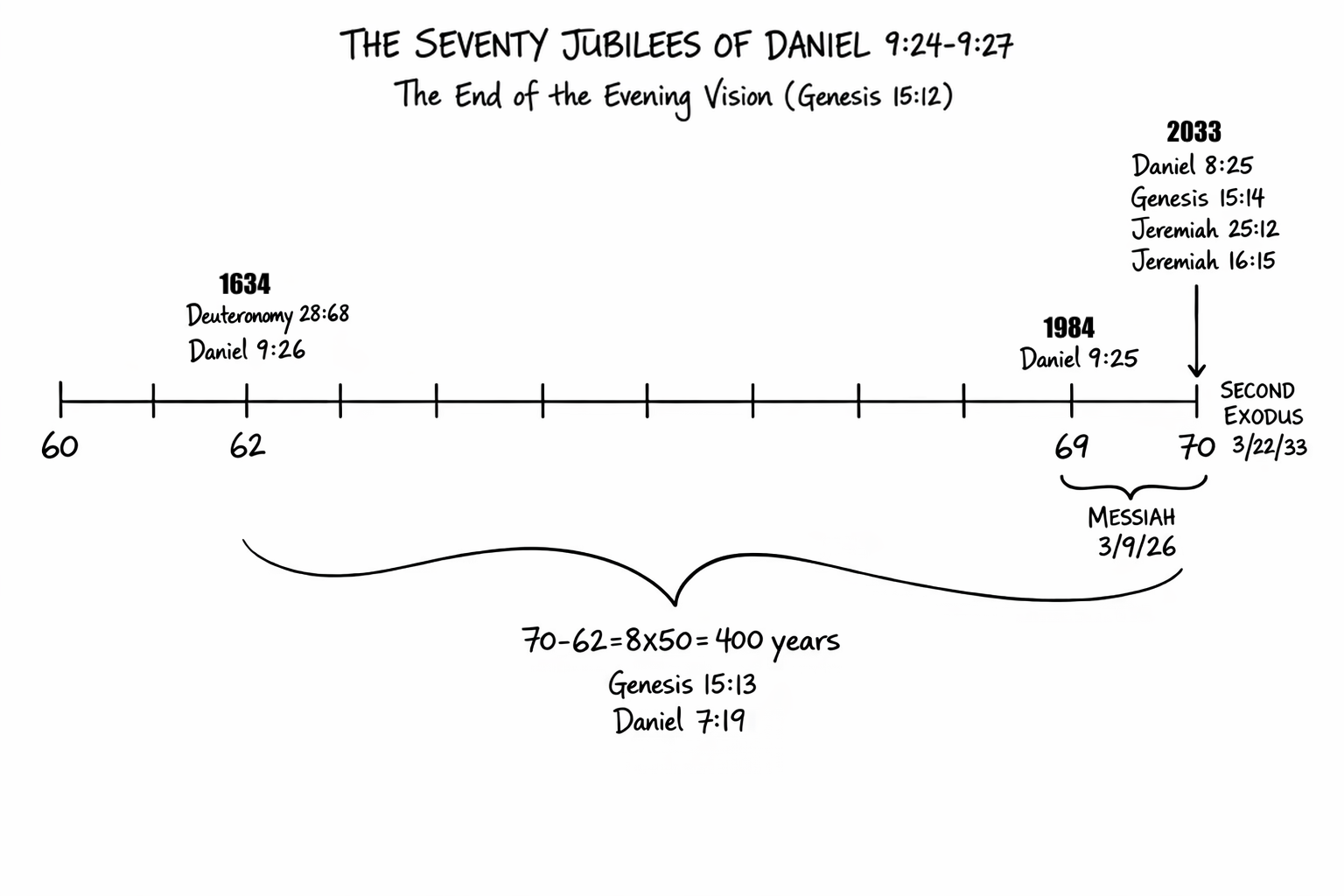
The numbers are not random. The timeline is not broken. Seventy jubilees, three thousand five hundred years, the middle of the week, the four hundred years of affliction — they all interlock with mathematical precision.
Weeping may endure for a night, but joy comes in the morning. — Psalm 30:5
The night is the evening vision. The thirty-five hundred years of darkness. The Babylonian captivity that has continued unbroken from the destruction of the temple until now.
But joy comes in the morning. The new day approaches. And the rod of the almond tree — the sign of the Messiah's resurrection — blossoms at the dawn of spring.
This is the second post in a series examining the prophecies of the Second Exodus. Next: Genesis 15:13-14 — the four hundred years of affliction and what comes after.
Continue Reading

April 24, 2026
Genesis 15:13 Was NOT Fulfilled in Egypt — The Mathematical Proof
If Genesis 15:13 was fulfilled in Egypt, it would be a statement of historical fact — not a prophecy. The math proves the children of Israel were never afflicted for 400 years under Pharaoh. Joseph lived 71 years with his brothers. The slavery lasted only 210. The numbers don't lie.

May 9, 2026
The Bird Is the Word of God
Isaiah 46:11 names two figures — a ravenous bird from the east and the man who executes God's counsel. The world teaches they are the same. They are not. The bird is the prophet Elijah. The man is David the Messiah. And he shall rise up at the voice of the bird.

May 3, 2026
The Dawn of a New Day: David Is the Sun of Righteousness
We are living in the darkest portion of the night. But the night is always darkest before the dawn. The Scriptures are filled with promises of a new day — and they all point to one person. David, the light of Israel, the sun of righteousness, rising with healing in his wings.
Discussion
Sign in or create a free account to join the discussion.
Loading comments…