April 20, 2026
Who Is the Prophet Like Moses in Deuteronomy 18:15? It's Not Who You Think

The Most Misunderstood Prophecy in Scripture
AO your God will raise up a prophet like me from among your brothers. You will listen to him. — Deuteronomy 18:15
You would be hard pressed to find a more controversial, disputed, and misunderstood prophecy in all of Scripture than Deuteronomy 18:15.
Entire religions have built their identity on this verse. Entire theological systems hinge upon its interpretation. Generations have claimed it points to their leader, their founder, their messiah.
Yet the current condition of the children of Israel demonstrates a reality that cannot be ignored:
This prophecy remains unfulfilled.
How do we know?
Test 1: "To Him You Shall Hearken" — A National Requirement
Deuteronomy 18:15 does not say some will hear, a remnant will hear, or the nations will hear.
It says: "To him you shall hearken."
This is a national requirement, not a symbolic one. The prophet like Moses is fulfilled only when Israel repents, returns from captivity, and finally obeys the voice of AO.
That day has not yet come.
Scripture testifies repeatedly that Israel remains scattered, blinded, and in captivity unto this day (Deuteronomy 28; Deuteronomy 29:4; Isaiah 6).
Therefore, Deuteronomy 18:15 cannot describe a first-century fulfillment.
The prophets tell us when Israel will finally hear:
I will bring you out from the peoples, and gather you from the countries . . . and I will purge out from among you the rebels. — Ezekiel 20:34, 38
This should sound familiar.
The thing that has been, it is that which shall be; and that which is done is that which shall be done: and there is no new thing under the sun. — Ecclesiastes 1:9
The pattern is the exact same as the First Exodus: a deliverer, a mighty hand, a stretched-out arm, the destruction of Israel's oppressor with plagues, and a purging of the rebels.
Those who refuse to hearken are removed. Those who obey are brought into the covenant and permitted to return:
. . . to the land that AO gave to their fathers, and they shall possess it. — Jeremiah 30:3
Only then can Deuteronomy 18:15 be fulfilled.
Test 2: "From Among Your Brothers" — A Priestly Context
Every scholar agrees that context is king — yet this principle is routinely ignored in Deuteronomy 18.
The chapter begins with the priests — the tribe of the priesthood (Deuteronomy 18:1).
This chapter is a legal statute governing priestly inheritance, priestly authority, and legitimate spiritual leadership. It also prohibits Israel from adopting the religious practices of the heathen nations:
9 Do not imitate the detestable ways of the nations there.
10 Let no one be found who sacrifices his son or daughter in the fire, practices divination or conjury, interprets omens, practices sorcery,
11 casts spells, consults a medium or spiritist or inquires of the dead.
12 For whoever does these things is detestable to AO. And because of these detestable things, AO your God is driving out the nations before you.
13 You must be blameless before AO your God.
14 Though these nations which you will dispossess listen to conjurers and diviners, AO your God has not permitted you to do so. — Deuteronomy 18:9–14
Then, in the very next verse, Moses says: "from among your brethren." (Deuteronomy 18:15)
Grammatically, "your" refers to the priests addressed throughout the chapter.
Just as Moses was an Ephrathite — born of the tribe of the priesthood (Exodus 2:1) — so the prophet like Moses must also arise from the same priestly order.
Context does not permit the audience to suddenly change for the final eight verses of the chapter.
Test 3: "Like Moses" — Defined by Scripture, Not Theology
"Like Moses" is not a vague phrase. Deuteronomy itself defines Moses' uniqueness:
10 And there arose not a prophet since in Israel like unto Moses, whom AO knew face to face,
11 in all the signs and the wonders, which AO sent him to do in the land of Egypt to Pharaoh, and to all his servants, and to all his land,
12 and in all that mighty hand, and in all the great terror which Moses shewed in the sight of all Israel. — Deuteronomy 34:10–12
Moses was a national lawgiver, covenant mediator, deliverer from captivity, judge of Israel, and executor of divine judgment against oppressors.
Any prophet "like Moses" must operate at the same national and covenantal level — not merely as a teacher or miracle worker.
Moses was not simply a preacher of righteousness. He was the agent of the First Exodus.
The Second Exodus Pattern
Scripture establishes that the deliverance Moses led would one day be surpassed, not replaced. The prophet Jeremiah distinguishes two Exoduses — the first led by Moses, and a second, greater in scope, led by a future deliverer:
14 Therefore, behold, the days come, said AO, that it shall no more be said, AO lives, that brought up the children of Israel out of the land of Egypt;
15 but, AO lives, that brought up the children of Israel from the land of the north, and from all the lands where He had driven them: and I will bring them again into their land that I gave unto their fathers. — Jeremiah 16:14–15
As it was in the beginning, so shall it be in the end.
The First Exodus establishes the pattern: a divinely appointed leader, national confrontation with an oppressor, judgment via signs and wonders, covenant renewal, and the regathering of Israel to the land.
The Second Exodus must therefore mirror these same elements.
The Rod of Authority
Moses' authority was not self-asserted but visibly conferred by AO through a staff:
And AO said unto him, What is that in thine hand? And he said, A rod. — Exodus 4:2
That rod became the proof of Moses' commission:
That they may believe that AO . . . has appeared to you. — Exodus 4:5
And it was that same staff which AO explicitly tied to the execution of His power as He judged Egypt:
And you will take this rod in your hand, wherewith you will do signs. — Exodus 4:17
Moses did not merely speak on behalf of AO. He acted on behalf of AO — like a right arm wielding divine authority to confront kings, unleash judgment, and redeem His nation.
Therefore, any prophet "like Moses" must likewise be divinely commissioned, publicly authorized, endowed with covenantal authority, sent to free Israel from captivity, and appointed to lead Israel through the Second Exodus prophesied in Jeremiah 16:15 — so great it will make us forget about the First.
Anything less does not meet the Scriptural standard.
A figure rejected by Israel, executed by a foreign power, and followed primarily by non-Israelites cannot satisfy Deuteronomy's own definition.
Why Joshua Cannot Be the Prophet Like Moses
Many who understand the above will argue that Deuteronomy 18:15 was fulfilled in Joshua, who was lifted up by Moses to lead the children of Israel into the promised land.
But the Torah itself forecloses this interpretation.
Joshua's appointment occurs in the same context in which Moses prophesies Israel's future rebellion that would follow his death after Joshua assumes leadership. Immediately after commissioning Joshua, AO says to Moses:
Behold, you will sleep with your fathers; and this people will rise up, and go a whoring after the gods of the strangers of the land . . . and will forsake Me, and break My covenant which I have made with them. — Deuteronomy 31:16
AO continues:
Then My anger shall be kindled against them in that day, and I will forsake them, and I will hide My face from them, and they shall be devoured, and many evils and troubles shall befall them. — Deuteronomy 31:17
And again:
And I will surely hide My face in that day for all the evils which they shall have wrought . . . — Deuteronomy 31:18
This rebellion is not hypothetical. It is certain. To ensure there is no misunderstanding, AO commands Moses to record an entire song as a witness against Israel:
Now therefore write you this song, and teach it the children of Israel: put it in their mouths, that this song may be a witness for Me against the children of Israel. — Deuteronomy 31:19
That song is Deuteronomy 32 — an entire chapter devoted to Israel's future corruption, apostasy, judgment, scattering, and eventual vindication.
Moses concludes with this final warning:
For I know your rebellion, and your stiff neck: behold, while I am yet alive with you this day, you have been rebellious against AO; and how much more after my death? — Deuteronomy 31:27
And again:
For I know that after my death you will utterly corrupt yourselves . . . and evil will befall you in the latter days. — Deuteronomy 31:29
This is decisive. Deuteronomy 18:15 requires a prophet to whom Israel shall hearken. Yet the Torah explicitly states that after Moses' death, Israel would rebel, corrupt itself, provoke AO, and be scattered.
Joshua therefore cannot be the prophet of Deuteronomy 18 — not because he was unfaithful, but because Israel did not hearken.
The Torah does not contradict itself.
Joshua is a faithful servant. He is a worthy successor. But he is not the prophet like Moses promised in Deuteronomy 18:15.
Test 4: "Raise Up" — What Does It Actually Mean?
Deuteronomy 18:15 says AO will raise up this prophet.
Most people read that phrase as political or spiritual promotion — as though God merely lifts a man into leadership, like He did with Moses.
But that distinction proves nothing. God appoints every prophet. Appointment is not unique.
If "raise up" meant only appointment, Deuteronomy 18 would provide no distinguishing characteristic for this prophet.
Moses did not use vague language. He used the verb qum (H6965).
So the question is not whether AO will appoint this prophet.
The question is whether AO will actually raise him.
And if so, then the next question is unavoidable:
Raise him from where?
This is the first of a series. The next post will answer the question the text demands — and reveal the identity Scripture has hidden in plain sight. The Resurrection of King David — Rod of the Almond Tree
Watch: David NOT Jesus!
The Resurrection of King David by the Prophet Elijah — told entirely through Scripture in 26 minutes.
Continue Reading

May 4, 2026
Ephraim Is My Helmet: The True Priesthood & Messiah Hidden in Plain Sight
Psalms 108:8 declares Ephraim is the strength of God's head — His helmet. If the helmet of salvation belongs to Ephraim, and David is of Joseph's lineage, then who is Levi? And what are the baker's and butler's dreams really about?

April 19, 2026
Did the Second Temple Exist? What Hosea 3:4-5 Actually Says
Hosea prophesied that Israel would abide many days without king, sacrifice, or priesthood — until David returns in the latter days. If this prophecy is true, the Second Temple never had divine authority. Here's what the text actually says.
April 18, 2026
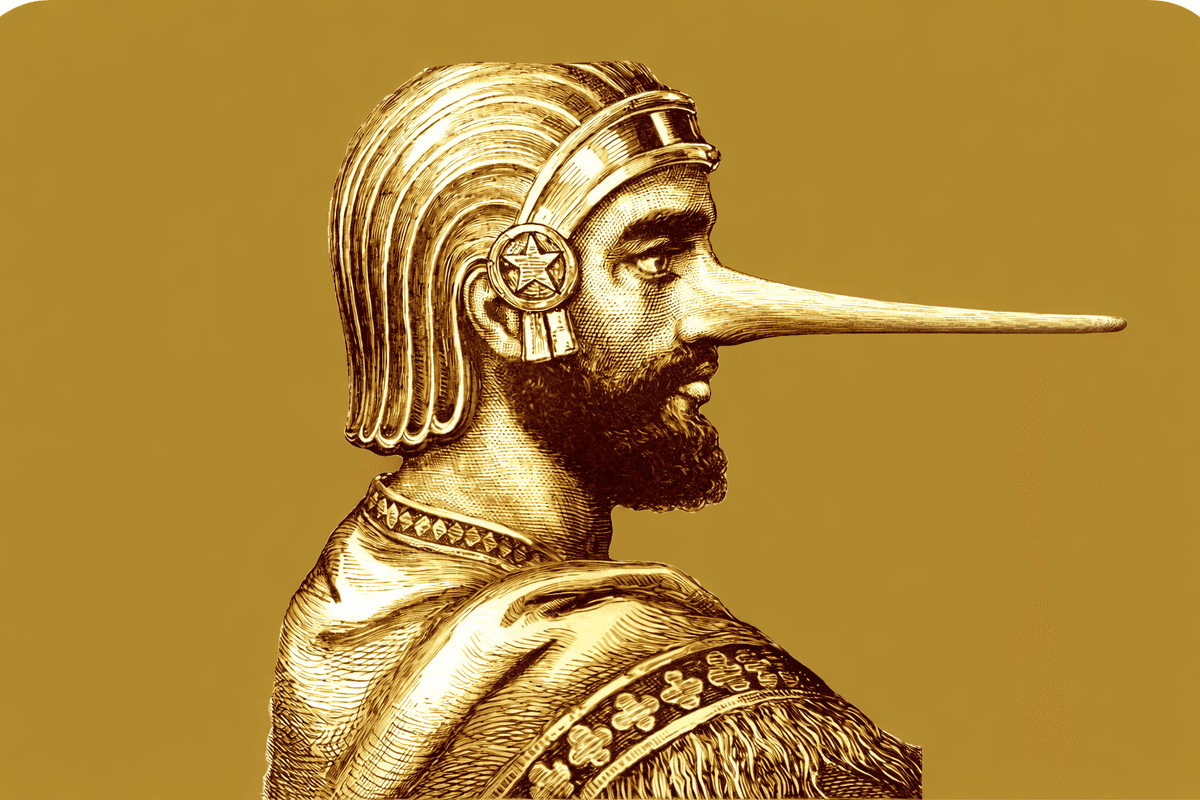
Cyrus the Great Deception: Why Isaiah's Anointed Shepherd Was Never a Persian King
Isaiah 44:28 names God's anointed shepherd who will rebuild Jerusalem. Every mainstream source says it's Cyrus. But Cyrus never kept Torah, never worshipped AO, and Babylon was never destroyed. What if the name was changed — and the captivity never ended?
Discussion
Sign in or create a free account to join the discussion.
Loading comments…